Ephesians Ten Thousand Feet Up
by G.S. Augustine
Not Getting Lost in the Weeds
Many of those who attempt to teach Paul’s letter to the Ephesians often get tangled up in theological debates over unconditional election, hair splinting definitions of total depravity, our helpless need of irresistible grace as well as the rest of sixteenth century debates. Although these questions need a legitimate forum for discussion, to make them the focus of study when trying to understand Paul’s message to a first century church living in one of the most pagan cities in Asia is to get lost in the weeds. Without putting too fine a point on it, Paul had never heard of the sixteenth century theologians and had never tried to invent a TULIP acronym.
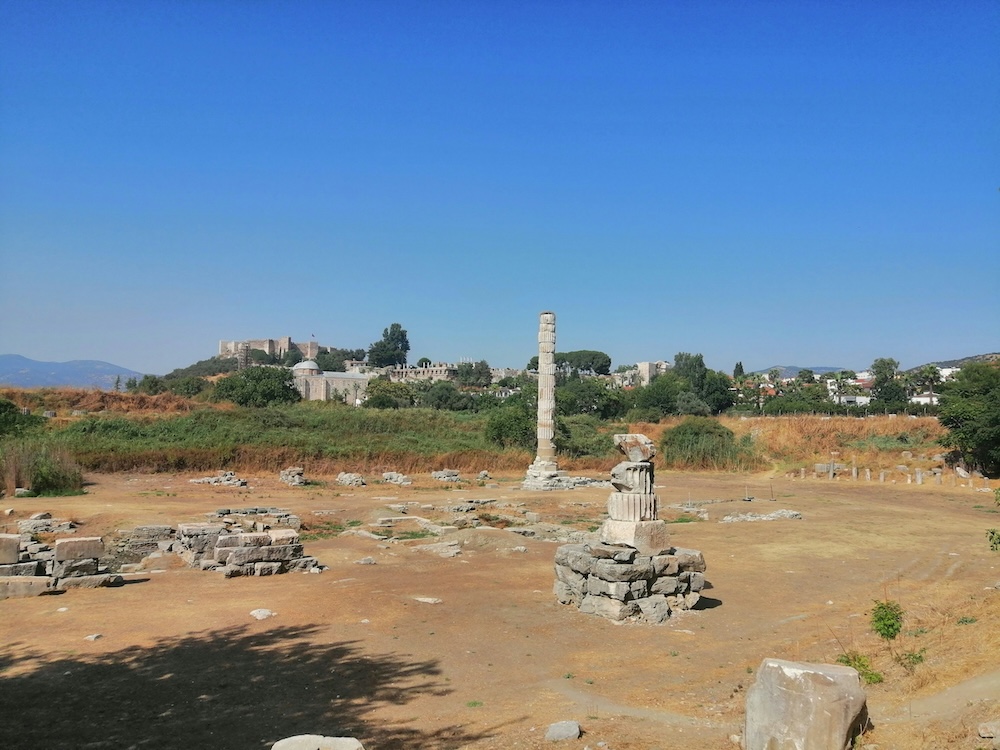
Ruins of Temple of Artemis like the one at Ephesus
Paul’s Immediate Aim
Rather, Paul’s intention was to provide Christians at Ephesus encouragement and tools to be light in a dark place. In Chapter 1, he begins by telling them that what God is doing in the present is no after thought or accident, and neither are they. God predestined it all since before the foundation of the world. Additionally, He planned to bless human beings with every possible blessing that would lead us to “holy and blameless” living. At first, that may not sound all that great. “Couldn’t we have a little more money and a little less aggravation?” you might ask. But the reason why this is amazing becomes clear as we move through the text. But more on that below.
What Ephesians 1 Does And Does Not Say
Paul says here that God “chose” us before the foundation of the world. The Greek word used is where we get our word “elect.” Many people jump on this to prove that God selected every person who he wanted to save beforehand and rejected those he didn’t. But careful observation will reveal that this passage doesn’t actually say that. Imaginative extrapolation can you get there, but it is not necessary to understand it this way.
Paul is simply trying to say that the church in its present form and characteristics are what God had planned from the beginning—which includes (believe it or not! … drum roll …) the hated “Gentiles.” In chapter 3, Paul says that this was the mystery of the ages and now revealed in the present. God had always planned to include not just Israel but all the nations, and Paul wants his readers to know this. Gentiles were to be included from the beginning. And not just second tier folks but as “adopted sons.”
The Ancient Value of “Adoption”
That again can sound to us like a consolation prize. Gentiles (which includes most of us!) might say, “Well, I’m not a real son, just an adopted one.” That is, a second class one. But in the ancient culture, particularly Roman culture, fathers often had many genetically conceived sons. This usually didn’t mean much. But upon coming into maturity, fathers would chose one or sometimes two sons and legally adopt them.
This and this only made them heirs of the father’s wealth. In ancient times, only adopted sons counted. And by the way, a father could chose a daughter to adopt as a son, thus making her the heir. Or a father might not even chose any of his own children and adopt another person outside the family who he might deem more worthy of the inheritance.
Can It Be True?
God’s decision to adopt the Gentiles before the foundation of the world would be a great honor for a favorite child let alone a “foreigner” (Ephesians 2:12). But God was pleased to do so. Paul says God did it according to the “good pleasure of his will.” The whole passages reads:
Praise be the God and Father of our Lord Jesus Christ, who has blessed us in the heavenly realms with every spiritual blessing in Christ. For he chose us before the creation of the world to be holy and blameless in his sight. In love, he predestined us to be adopted as sons through Christ, in accordance with the good pleasure of his will to the praise of the glory of his grace he had freely given us in the beloved one in whom we have redemption through his blood, the forgiveness of transgressions, according to the riches of his grace which he lavished on us in all wisdom and understanding. (1:3-8)
Is This a Good Idea?
So, just in case anyone might wonder if all this grace “lavished” on sinners might be a foolish endeavor, Paul adds that God did it with “all wisdom and understanding.” And the purpose of all this was to bring all the various chaotic parts of this fallen world into order under one head, that is his Son.
And he made known the mystery of his will according to his good pleasure which he purposed in Christ, to be put into effect when the times will have reached their fulfillment—to bring all things in heaven and in earth together under one head, that is Christ. (1:9-10)
Reconciling All Things
In a world that is fraught with war and crime and deceit and betrayal, one might wonder where is God in all this? Is it that he doesn’t care? Does he lack the power to do anything about it? Paul proclaims loudly that God has been doing nothing but putting in place a plan to completely heal every broken thing for all eternity. And he did it in a way that you and I could lavishly benefit.
Paul’s point is that we can live with such utter confidence in God that we aspire to live up to the calling—that is, so that we would be “holy and blameless” in his sight. “Ah, there’s the catch!” you might say. We have to be good and have no fun. Below, we will discover why being holy and blameless is really everything we are looking for in this life. We just don’t know it. But before we get there, he wants to make sure we understand just how safe we are in this plan of God.
Adding An Air-Tight Guarantee
Having believed, you were marked in him with a seal, the promised Holy Spirit who is a deposit guaranteeing our inheritance until the redemption of those who are God’s possession, to the praise of his glory. (1:13-14)
We can be confident in God’s plan because we see that is has become a reality in the present. But if we are wondering whether it will last, He has also provided us a guarantee. And that guarantee comes not in the form of a legal document to be later disputed in court. God gave himself to us in the form of the Holy Spirit. It is a guarantee that cannot be broken.
Just Knowing It Isn’t Enough
But even with all this, Paul is aware that we still need something more. Just being told about these things won’t be enough to get us to bet our lives on it. We will need a direct experience with God and his help. Paul prays constantly that God gives his readers “a Spirit of wisdom and revelation” so that they go beyond hearing about God’s love and power and experiencing them. God will have to reveal himself to their hearts. And Paul turns to prayer to ask God for that very thing.
Paul prays that their “inward” sight be enlightened. He asks that God directly reveal himself so they will be able to fully comprehend the incredible hope they possess. Then Paul wants them to know something else—something we often miss: we are God’s “rich” inheritance. God’s great treasure for himself is us! And because we are what God treasures, he offers his “incomparably great power for those who believe.” God is powerfully available to help and bless.
Not A Matter of Talk But Of Power
This notion of God’s power available to those who believe is a prominent theme in this letter. And Paul wants his readers to understand how great this power is:
That power is like the working of his mighty strength which he exerted in Christ when he raised him from the dead and seated him at his right hand in the heavenly realms far above all rule and authority, power and dominion and every title that can be named, not only in the present age but also in the age to come. And God placed all things under his feet and appointed him to be head over everything for the church, which is his body, the fullness of him who fills everything in every way. (1:19-23)
Wow, that is a traffic jam of language attempting to make the enormity of God’s power clear. This power of God conquered death and placed Jesus above every power everywhere forever. But that’s not all. This power in Christ is for the church, which Paul says is Christ’s very body. And it is the body of him “who fills everything in every way.”
We Must Be Convinced In Our Hearts
To live up to our calling, our hearts must fully comprehend this enormous power on our behalf. And if we still have any doubts the connection between Christian living and God’s power, Paul prays again in chapter 3 stressing this idea even further. But this time he connects this power with the incredible love Christ has for us. Notice how heavily he emphasizes the word “power” in this passage.
I pray that out of his glorious riches, he may strengthen you with power through his Spirit in your inner being, so that Christ may dwell in your hearts through faith. And I pray the you, being rooted and established in love, may have power, that you together with all the saints may know how long and wide and deep and high is the love of Christ, and to know this love which surpasses knowledge, that you may be filled to the measure of all the fullness of God. Now to him who is able to immeasurable more that all we ask or even think, according to the power that is at work within us, to him be glory in the church and in Christ Jesus throughout all generations for ever and ever, Amen. (3:16-21 emphasis mine)
Not For Theological Musings
If we conclude that Paul wrote Ephesians so we might simply say we just got lucky in the election lottery, we miss Paul’s point entirely. Paul tells the believers at Ephesus that God ordained their victory in Christ before he created anything so that we may have confidence to live a certain way. To imply that Paul teaches here that believers had no choice but to believe in Christ is going beyond the text. “Ah, but what about chapter 2?” you might say. “Doesn’t Paul say that our salvation is not as a result of works? Weren’t we dead in our sins? Aren’t dead people unable to do anything at all?” To this we will now turn.
To The Jews, Gentiles Were “Outside”
The two prayers of Paul in Ephesians 1 and 3 from a kind of inclusio bracketing chapter 2 and the first half of chapter 3. But before we go off the rails and stretch a metaphor on how dead people can’t do anything at all, let’s look at the whole context. Most readers of chapter 2 pretty much stop at verse 10. But the rest of the chapter is about the fact that Gentiles were completely cut off from God:
… you who were Gentiles by birth and called “uncircumcised” by those who call themselves the “circumcision” … remember that at that time you were separate from Christ, excluded from the citizenship of Israel and foreigners to the covenants of promise, without hope and without God in the world. But now in Christ Jesus you have been brought near through the blood of Christ. (Ephesians 2:11-13)
In Ephesians, Paul is addressing an audience made up of mostly Gentiles. Even if in the Ephesian Church there were Jews, from 2:11-13, we can see that he is specifically speaking to Gentiles. Paul’s statement “As for you, you were dead in your transgressions and sins” is a pretty good summation of verses 11-13. Paul, as he does in several letters, is defending the inclusion of the Gentiles in the church. The Old Testament Scriptures, which they had access, points out that Gentiles are “outside” God’s covenant with Israel. But now in Christ, Paul says, they are part of the people of God.
What “God’s Choosing” Really Aims At
I am arguing here that Paul is not trying to affirm the Calvinist doctrine of election in this letter, but rather to provide the Gentiles with confidence that God had always loved them and always planned to work powerfully on their behalf. How this “choice” of God works may be debated, but Paul doesn’t define it here or really anywhere else. The attempt to do so, I believe, is unwise and risks going beyond and distorting the text.
Paul wants his readers to focus on God’s power and love on their behalf, “see” with their hearts how wonderful the hope to which they were called, how much God treasures them, and his incomparably great power for believers. Speculating on “how” God chose them is a distraction from the point. Paul doesn’t do it; I would suppose, neither should we.
As Gentiles, They Were Dead
Between the two great prayers of Paul, he reminds these believers that they were one time separate from God as Gentiles. He speaks in 2:1-2:
As for you, you were dead in your trespasses and sins, in which you used to live when you followed the ways of this world and the ruler of the kingdom of the air, the spirit who is now at work in those who are disobedient. (Emphasis mine)
If we compare this to Ephesians 4:17, we see the same language, this time using the term Gentiles as those outside the church.
So I tell you this, and insist on it in the Lord, that you must no longer live as the Gentiles do, in the futility of their thinking. They are darkening in their understanding and separated from the life of God … (Ephesians 4:17-18 emphasis mine)
The words “no longer live as the Gentiles do” means that they use to live as the Gentile still do now. The average Jew would not likely describe himself in this way. It resonated with Paul’s readers precisely because they really did use to live that way. The parallel with 2:1 makes a good argument that Paul refers here to way Gentiles in particular lived. Those behaviors excluded them from God’s people. But now because of Christ they are “brought near.” In view of God’s covenant with Israel, Gentiles were truly dead in their sins and without God in the world. This doesn’t mean that all people weren’t also dead in sin. It’s just that Paul’s language here is describing Gentiles as “outsiders,” not an ontological description of a man’s spirit as if it was a length of toilet paper dragged along by the person’s heal.
Groundwork for Holiness
Rather, Paul is laying the groundwork for why these Gentiles must now live a life of holiness. God decided long ago to bless them and include them in his kingdom. But without holiness, we would gain no advantage from it. God can be trusted to be faithful to his word precisely because he is holy. And whether we realize it or not, holiness is the very thing we have been looking for all our lives. Holiness is the only antidote to war and death and violence and deceit and pain and lost and all the injustice we decry in this world.
But before Paul speaks about how this must look in detail, he answers a question assumed to be on the minds of his readers. “If God planned all this, how come we never knew about it?” He explains that the inclusion of the Gentiles was not revealed in the previous generations. But now it has been revealed to the apostles and prophets (3:5), particularly to Paul (3:2). From verse 7 on, Paul explains his calling to the Gentiles on this in detail. He rounds out the chapter by praying those very Gentiles fully perceive God’s love and power. With that cleared up, Paul then turns to how all this must be lived out.
The Point of Recounting God’s Grace to Gentiles
When we get to chapter 4, Paul begins to explain why he spent the first three chapters telling the Gentiles these things. He sums up the entire thing in 4:1:
As a prisoner for the Lord, then, I urge you to live a life worthy of the calling you have received. (emphasis mine).
Paul has already hinted at what he means by this in chapter 2:10:
For we are God’s workmanship, created in Christ Jesus to do good works, which God has prepared in advance for us to do.
God has done everything we needed to redeem us, but for actual benefit to acrue to us in the present, we have responsibilities to fulfill. This is going to take practicing certain character qualities: humility, gentleness, patience and love (4:1-2), all of which are fruits of the Spirit (see Galatians 5:22-23). And not surprisingly, Paul immediately mentions the Holy Spirit in verse 3, but this time “making every effort to maintain the unity of the Spirit in the bond of peace.”
Maintain not Create
Notice that we do not “create” unity but are to “maintain” unity that the Holy Spirit has created. We can’t make it happen. Only God could through Jesus fulfilling his Father’s will. We, however, can gum up the working out of that accomplishment in the present by continuing in our sinfulness. And that continuing in sin may indicate a serious concern. In 2 Corinthians 13:5, Paul admonishes the believers in Corinth:
Examine yourselves to see whether you are in the faith. Do you not realize that the Spirit of Christ Jesus is in you—unless of course you fail the test.
The Corinthian Church was rife with sectarian divisions. Paul condemns their behavior in the strongest of terms. For those in a body of believers who don’t seem to have any capacity for unity, we may even rightly question whether their faith is genuine. So here in Ephesians 4:2 Paul prescribes the kind of character qualities necessary for that unity. But the ability to practice qualities like these consistently comes to people who are confident in God love “which surpasses knowledge” and his ability and willingness to do “immeasurably more than all we ask or even think.” Without this confidence, when things go south, its every man for himself.
Theology Chapters and Practical Chapters
Bible teachers often refer to Ephesians 1-3 as Paul’s teaching on theology and Ephesians 4-6 as Paul’s teaching on Christian living as if they are two separate discourses. The first is simply what Paul want us to know, and the second is what Paul wants us to do. I believe this notion to be a faulty way of reading any of Paul’s letters. In the first place, in Ephesians 1-3, Paul is not aiming at simply “knowing” these things, but rather that the Ephesian church would deeply “experience” these things. He uses the word “know” in that sense.
Secondly, in Chapter 4 Paul continues with “theological” teaching almost immediately.
There is one body, and one Spirit—just as you were called to one hope when you were called—one Lord, one faith, one baptism, one God and Father of us all. But to each one of us grace what give as Christ apportioned it. (Ephesians 4:4-7)
Regularly Intermixing the Two
Then, in the next verses Paul quotes and explains Psalm 68:18. But if we listen closely to Paul’s explanation in verses 9-10, we will hear an echo of an argument Paul makes Romans 10:5-13 where he exegetes Deuteronomy 30. There he highlights a different idea, but it is good to note that Paul intermixes theological ideas with his call to live up to them.
In the call to maintain the unity of the Spirit, Paul explains that to get this right, each member must use his or her gifts (see 4:16) to build up the body of Christ. We have been given powerful gifts to use for that purpose. It is easy to see why qualities like humility and gentleness are necessary. As Paul argues in 1 Corinthians 12, certain showy gifts cannot safely disregard the gifts that “require more modesty” (1 Corinthians 12:23). Additionally this “building up” is to continue “until we all reach the measure of the fullness of Christ.”
Again if we are paying close attention, we will recall that “reaching measure of the fullness of Christ” is what Paul prays for in Ephesians 3:19. The passionate use of our gifts to build the body of Christ in some manner connects to our “experience” of the love and power of God in Christ. And it is also the foundation of a life that no longer lives as we use to live (v. 17).
Not By Human Willpower
Paul is not saying simply for them to grit their teeth and willpower their way to new life, but he is saying that out of their experience of God’s power and love, they must reject the practices of their former life because those practices didn’t lead them to Christ—if fact, they kept them from him.
You however, did not come to know Christ that way. Surely you heard of him and were taught in him in accordance with the truth that is in Jesus. You were taught with regard to your former way of life to put off your old self which is being corrupted by deceitful desires … (Ephesians 4:20-22)
He enumerates these desires to put off in 4:25-32: falsehood, sinful methods of expressing anger, stealing and idleness, unwholesome talk, grieving the Holy Spirit with bitterness, rage, anger, brawling, slander and malice. Instead they must rather be kind and forgiving.
Living Rightly Because Darkness Abounds
Then Paul sums up what he is talking about by linking his admonitions in these paragraphs with what he had been driving at in the first four chapters:
Be imitators of God therefore as dearly loved children, and live a life of love, just as Christ loved us and gave himself for us as a fragrant offering and sacrifice to God (Ephesians 5:1-2 Emphasis mine; notice the recurring theme with Paul’s prayers)
Notice the connection between imitating God and our status as “dearly loved children.” The wild blessings of God are conveyed through our imitating the “holiness of God” as dearly loved children. And there are some very deadly practices we must not allow even a foothold if we are going to “imitate God.” : sexual immorality, impurity, greed, obscenity or foolish talk or course joking.
The antidote to these are a life of thanksgiving. Again if we are careful observers, Paul is suggesting that sexual immorality, impurity, greed and the like are the result of and evidence for our ungratefulness toward God. This is essentially idolatry and alien to a kingdom ruled by the one God. He makes it clear that these are practices of darkness in a very dark world, and we are now children of light (5:8-14)
Staying Focused And Drunk On God’s Spirit
So Paul warns his readers to be careful in this dark world. He will go into detail on how to prepare for it in Ephesians 6 but here he warns his reader to stay focused:
Be careful, then, how you walk, not as unwise but as wise, making the most of your time for the days are evil. Therefore do not be foolish but understand what the will of the Lord is. Do not get drunk on wine … but be filled with the Spirit. Ephesians 5:15-17
Here Paul may be thinking of Psalm 90 where the author there says: “Teach us to number our days so that we might present to you a heart of wisdom.” Proper use of time is necessary if we are to be wise and understand what God’s will is. Therefore instead of imbibing wine to intoxication, we need to regularly imbibe the Spirit of Christ in worship.
Submit to One Another As Appropriate
He finishes the chapter and begins chapter 6 by directing each category of members of the body of Christ to maintain the unity of the Spirit through their appropriate submission to one another: wives to husbands, husbands to wives, children to parents, fathers to children, slaves (or employees!) to masters, and masters to slaves. (It is important to note that Paul is not advocating slavery but simply acknowledging that is exists and how to live surrendered to Christ in the midst of it).
Get Battle Ready To Engage Powerful Enemies
Lastly Paul reminds the believers at Ephesus that there is more going on in the world than just experiencing Christ’s love and living a life worthy of it. God’s power is not just for them to rely on in their need for food, clothing and shelter. There is a battle going on and they will need to harness God’s power to be able to stand against a most daunting set of enemies:
Finally, be strong in the Lord and in his mighty power. Put on the full armor of God so you can take your stand against the devil’s schemes. For our struggle is not against flesh and blood but against the rulers, against the authorities, against the powers of this dark world and against the spiritual forces of evil in the heavenly realms. (Ephesians 6:10-12 emphasis mine)
He uses the armor of the Roman soldier to identify God’s armor and how to use it which is a marvelous study to meditate on. He then ends with the most powerful weapon of all: prayer. And prayer is to be done constantly and in every situation (6:18-20)
The Bullseye of the Letter to Ephesus
Paul waited to discuss the raging battle we face against powerful and supernatural enemies to the end of this letter. But it was in fact the bullseye of the target he has been aiming at from the very first verse. All that Paul taught before is so that the believers at Ephesus would be in the proper mindset for the battle they would face. Ephesus was the place where Paul faced his most challenging persecutions. In his second letter to the Corinthian church, he says about his imprisonment at Ephesus:
We do not want you to be uninformed brothers about the hardships we suffered in the province of Asia. We were under great pressure, far beyond our ability to endure, so that we despaired even of life. Indeed, in our hearts we felt the sentence of death. But this happened that we might not rely on ourselves, but on God who raises the dead. (2 Corinthians 1:8-9)
Failures of the Past
The Israelites under Moses refused to go into the land at Kadesh Barnea. They thought God had brought them there so their enemies could kill them. Israel had not prepared themselves for the battle. Paul tries to prevent his readers from the same failure. The Israelites didn’t understand God power or his love. They didn’t understand God’s plans for them had been established before the foundation of the world. They weren’t thankful for what he had done for them but only grumbled about what God hadn’t done for them yet. They engaged in idolatry, sexual immorality and greed. Though Paul talks specifically about armor in Ephesians 6, the separate pieces of that armor allude to various subjects of all Paul’s teaching in the first five and a half chapters of the letter.
A Message for the Present
The letter to the Ephesians has many characteristics that relate to the socio-geographic context of the ancient Near East and the City of Ephesus in the first century AD. But ultimately his admonition to the church at Ephesus is the same one he makes to us: Embrace God’s love and power so that you can live a life worthy of your calling and stand against the devil’s schemes.